Echoes of Traumas Past

“Then one day, the echo of sobs from months long past bounces back. We hear the sorrow, grief, loss, and pain, and it’s almost too much to revisit. My God, what do we do with this wayward emotion we thought long gone?

If this is your first visit to my blog, welcome and let me explain its focus. Harm OCD is a form of obsessive-compulsive disorder where one has a recurrent fear that they might harm themselves or others. These are not bad, violent, or crazy people. These are just people who have a door stuck open inside their brains, and the same thought keeps walking through on a terrifying loop. Unfortunately, willpower or logic won’t fix it; you need to find an experienced therapist.

It’s been about 9 months since my teenage daughter experienced a Harm OCD break down—the kind where I find her on the floor, curled into a ball, shaking, crying, telling me the images in her head won’t stop. Nine months since a serious bout of Harm OCD has wrapped its dark embrace around her and tried to suck the joy out of every moment, whisper in her ear and tell her the images she sees in her head might be true. After much trial and error, we found a great therapist with decades of experience treating Harm OCD, and I’ve seen my daughter come back from the brink of despair. She’s able to get out more, laugh more, sleep better, and in short, enjoy her life again. Until one day…

“Today feels weird,” she says as she crosses her arms on the kitchen table and lays her head down across them.

At her words I get a panicky feeling in my stomach and try to trace it to its source: I’m nervous.

“Are you feeling okay?”

She props her chin on her arms. “Yeah, I don’t know.” She sighs.

Oh. God. My heart starts pounding. It can’t be happening again. Everybody is entitled to a bad day. She’s on the right track. Calm down.

It all comes rushing back. The years of finding her wailing, terrified. Asking me if she deserves to live despite the horrific things she imagines herself doing. Years of this sweet, compassionate, kind-hearted soul looking up at me with tear-stained cheeks, begging me to tell her she’s not a murderer. Years of knowing a mother’s love, as powerful a force as it is, cannot get inside her skull and fix this. I tell myself the same thing I’ve told her many times. Breathe—everything is going to be okay.

“Hmm, yeah,” I say. “We all have days like that sometimes. I was feeling a little meh earlier too.”

 It’s a fine line, really. No one wants to be dismissive of someone in therapy. At the same time, if we launch into our fears—Should we call your therapist? What kind of thoughts are you having? I thought you were okay?—we may place a burden on someone to start caretaking our feelings. God knows a person with OCD, especially an empathetic soul like my daughter, has a keen eye for other people’s feelings.

She yawns, gets up, walks into the kitchen, and makes a bowl of soup. Life.

Breathe. Everything is going to be okay.

And it is. She’s still moving forward. It was just a tough day, and it did pass. But I realize what a mark OCD leaves on us. As it’s happening, we are so busy putting one foot in front of the other, coping, surviving, there’s no time to stop and process. Then one day, the echo of sobs from months long past bounces back. We hear the sorrow, grief, loss, and pain, and it’s almost too much to revisit. It squeezes our chest and demands our attention. My God, what do we do with this wayward emotion we thought long gone?

The OCD Walk Georgia is coming up, and we’ve been asked to think about why we will walk. There are so many ways to answer this question, but one answer is, I walk because even when I think this battle is over, it ain’t over. I don’t know that one is ever cured of OCD. We learn to manage it. I walk because somewhere someone is looking for the answers that I was when I found my daughter sobbing and asking me if she deserved to live. They are still looking for the answers that I was when Harm OCD hit me at the age of 13, and I had no idea what it was either. I walk because there’s still research to be done, education needed.

 I walk because an ungrieved trauma needs somewhere to go.

Confrontation vs. Conversation

“Ask anyone who has stood up for what they believe in, OCD or not. Most valiant moments start out with the hero about to vomit.”

My daughter has come a long way from the dark days of lying on the floor sobbing while deep in the throes of OCD’s demanding embrace, and so have I. At different times in our lives, we both managed to slip free from the bonds of scrupulous obedience, which promises assurance but delivers none. We’ve learned strategies, gained perspective, climbed the hill, and vowed to share what we’ve learned. So now that I have all this information and, at least to my thinking, moral responsibility to speak up, what will I do with it? When I’m confronted with misguided individuals using OCD to land a joke or sell a product, how will I respond? I should educate and inform. Spread the word, right?

Well, dear friends, take it from me, the Universe is listening. No less than 24 hours after asking myself this grand question, I visit a street fair and look up to see a vendor with a giant banner that reads “OCD Fashions for You.” Well, bless my crusading soul. I wanted to know what I’d do in such a situation, and the Universe said, “Wish granted. Have at it, Slick! Let’s see what ya do with this.” The Universe snickered, grabbed a glass of lemonade—it was a hot July day in the Deep South and the Universe had sweat running down its back like an OCD sufferer filled with righteous indignation and ready to make a point—no wait that was me. At any rate, the Universe sat back to watch me mumble and stumble my way through this lesson in practicing what I preach. After all, my last blogpost was about the annoyance of watching someone take a disorder that has stolen countless hours, years, and lives from its victims and reduce it to a cliché to market hand sanitizer. I’m ready. Nerves be damned. This is happening.

We know that declaration sounds brave in theory, but in practice it feels like a pounding heart, shaking hands, and a churning stomach. Ask anyone who has stood up for what they believe in, OCD or not. Most valiant moments start out with the hero about to vomit.

But then I notice…the vendor is a sweet-looking individual with an innocent smile.

“Hey, how’s it going?” she asks.

“I’m good, thanks. These skirts are absolutely lovely. The colors are so vibrant.” I feel oddly calm. I don’t want to go to war with anyone. I’d rather simply connect.

“Thank you! I made all of them. Each one is unique.”

“Well, they’re fantastic.”

“Thank you.”

Even as I gear up to ask her what I really want to know, there are no nerves and no defensiveness. I realize something about her that is so easy to forget in a world where we seldom meet face-to-face anymore. She likely needs and wants the same thing most of us do: connection, understanding.

“What does the OCD stand for in the name of your business?”

“Oh, when I make these skirts, I have to have each one just right or it drives me absolutely crazy. I have to take them apart and redo them until they are right, but I feel like I can’t stop making them either. So, I thought, why not just call it OCD Fashions for You?”

Not what I would have chosen, but this is a dialogue about mental health. Not an argument. Keep it open. “Okay, yeah, my daughter and I suffer from OCD, and I also write about it, and so your banner just caught my eye. Does it bother you, too, when people who don’t have OCD or don’t really understand what OCD is use it to sell things, or like when someone says they have OCD just because they like things neat? They aren’t panicking because it isn’t neat. Yet they tell people, ‘Oh, I’m so OCD’ or ‘You’re so OCD.’ Does that frustrate you?”

“Yeah, I doubt they’re waking up in the middle of the night to fix something.” I look into her eyes, searching for that same fright I’ve seen in the mirror after a night of checking the front door over and over again until I’m breaking out in a cold sweat as I did many years ago. I search them for the same helpless terror I detected in my daughter’s eyes that brought me to my knees, begging God and the internet for help, combing the library shelves and insurance databases before finding the right therapist for her. Did I see this same horror in this woman’s eyes? Truthfully, I’m not sure.

The lady really was a sweet soul, and we had a lovely conversation. I got a new skirt. Though I still don’t know whether she has OCD, I’m not a health professional, and it isn’t my place to judge. And yes, personally I would feel better if she would name her business something else. After all, I haven’t heard of Cancer Creations or Parkinson’s Pastries because that’s wildly offensive, yet it’s somehow okay to use OCD in this way. One thing I do know for sure is that very few people ever change, for the better at least, with scorching accusations and ego-driven diatribes, but connection-driven dialogue from one human being to another can work wonders. Planting seeds that bloom later is a very real phenomenon.

And speaking for myself, I learned exactly what I would do when faced with a situation where I needed to stand up for what I believe in. I’m happy to report that the Universe is full of opportunity to grow and connect, to trade in ego for our better angels of understanding and compassion. I’m happy to say that when we think we are looking for confrontation, what we are often seeking is simply connection. But I’m most happy to report that…

The Universe is listening.

Our Struggle Is Not Your Cliché

If the palms of the hands told the future, as some believed, then her present was written for all to see, painful, burning obsession, not content to be contained inside her mind, but making its presence known for the world to see, slashing its way across her skin.”

Recently, other members of the OCD community and I have called out several retailers that have marketed hand sanitizers as “OCD survival kits.” Why did that labeling hit us like a slap, a bucket of cold water, but most of all like trying to put lotion on hands that are bleeding from the chronic hand washing brought on by obsessive compulsive disorder? It is a massive misconception that OCD only has to do with cleanliness. For the sake of this blog post, we are talking about the torment of obsessive handwashing, but as I’ve written about previously, there are many types of OCD: harm, checking, scrupulosity, morality, and the list goes on.

I realize that some misguided marketing hire might not understand what they are doing when slapping “OCD survival kit” on a package in a clichéd attempt to sell hand sanitizer. Because knowledge is power, let me explain why this is so hurtful by citing a real-life example. Many years ago, my third grader came home from school with hands that were cracked and bleeding. For weeks, I had noticed them getting progressively drier, redder, until one day…

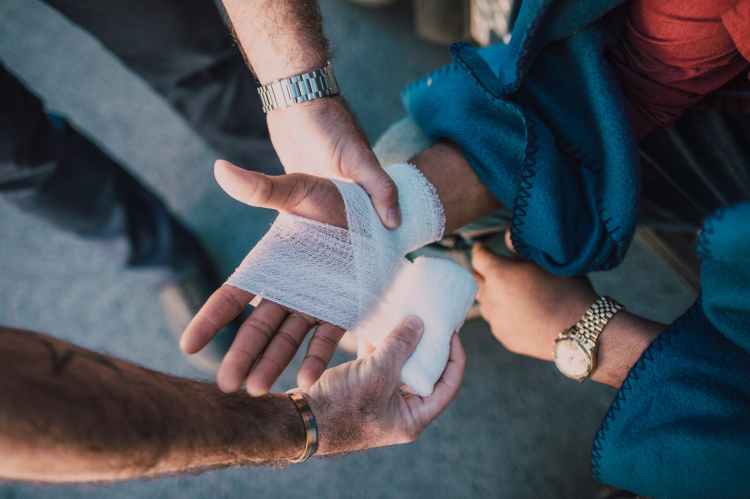
My daughter walked into the living room, pulled her backpack from her shoulders, and I noticed the jagged, red lines that scored her hands. If the palms of the hands told the future, as some believed, then her present was written for all to see, painful, burning obsession, not content to be contained inside her mind, but making its presence known for the world to see, slashing its way across her skin.

Tears sprang to my eyes as I noticed the bright red through the cracks, blood not yet pouring from the lines but visible in each one. I swallowed hard, not wanting her to hear the panic in my voice. “Stop using so much soap,” I pleaded.

“At school, they tell us germs are everywhere. Besides, I like the foamy stuff.”

“But you’re tearing your hands up.”

“Yeah, they sting.”

I grabbed a bottle of lotion from the counter, squeezed a generous amount in my palm, and proceeded to rub her hands with it. Tears gathered in her eyes.

“Stop! That burns.” She yanked her hands away.

“But it’s going to get worse if we don’t do something. Sweetie, you have to stop washing them so much.”

“I’ve already told you. I can’t.”

“Why?”

“I just can’t.”

My daughter is now nineteen years old, and it has taken years of therapy to get the hand washing, among the many other forms of OCD she wrestles with, under control.

She has never been a neat freak. Her room is messy. Her bathroom is even worse, and that sink that she scrubs her hands in until they bleed, sports dried toothpaste and hair clippings mingling with old soap residue—not at all the fastidious image that comes to mind when many people think of OCD. And while we are at it, it is neither cute nor funny to tell your friends that they are “so OCD” because they like to have things neat. OCD is a serious neurological disorder. If your friend is in the floor crying, panicking, and considering ending their life because they can’t get their sock drawer arranged just right, then yes, they might have OCD, but even then, it would be worth a serious talk with your friend about finding a skilled therapist, not firing off a flippant comment meant to shame and tease. Despite what many may conclude, OCD is not simply a disorder for people who get annoyed if things aren’t tidy. While there is a spectrum to OCD like most things in life, if you can walk away from it without panic, or at least extreme discomfort, then it likely isn’t a disorder.

In short, using OCD to market hand sanitizer is insulting at best, enabling and dangerous at worst, and retailers should not have to be asked repeatedly to remove this wording from products and advertising. A company that cares would understand that words matter and listen the first time.

Born Too Soon for Help

“For me, his kindness is not diminished by what he felt he had to do to survive. I remember a sweet old man communing with feral kindred spirits, moments of peace with feline vagabonds.”

My family and I sat in our Buick and watched as a sweet old man with snow white hair, a worn charcoal gray fedora, and dress slacks held up by bright red suspenders stumbled down the street of my small Georgia hometown. He held a liquor bottle wrapped in a brown paper sack. I had never seen him drunk before. I just remembered my grandfather as perpetually kind with a never-ending supply of circus peanuts and peppermint sticks in the pockets of his old sport coat. I was too young to understand what was going on at the time. We drove away without him ever knowing we’d seen him. My mother cried the whole way home.

His small, run down house was home to every stray cat in the neighborhood but no one else. He faithfully fed them, and they kept coming. Long divorced, with grandkids popping in occasionally, he knew more cats than people.

“Here, kitty, kitty. Poor kitty,” he would say as he sprinkled food over the ground for the feral horde. I was a little girl then, but I saw his compassion as he watched the cats pop up one by one about the same time every day, tentatively, slowly, scared. “Poor kitty.” He stooped down in well-worn dress shoes, their shine lost long ago from the dust, years, and small-town poverty, to hold out a hand to a cat at once wanting to approach but too frightened at the same time. This was long before rescues were fashionable and the good graces of people like my grandfather were where these starving cats turned for help.

Inside the house, he had stacked junk to the ceiling. I couldn’t understand why he would hold on to so much stuff and refuse to throw it away. I was even told he kept what little money he had hidden in the walls, perhaps a carried over fear from living through the Great Depression. I remember the nerves he experienced while driving. The panic he went through when he spotted a police car. He had done nothing wrong, and yet he would slow down so much that he would get pulled over for going too slow. I was told that no one could think of anything that had happened in his past to make him panic like this.

His old post office box could be identified immediately by the smudges around the lock. On many occasions, I watched him attempt to leave the post office, get halfway out, and turn around to go make sure the box was still locked. There was no handle to pull on the small door of the box and confirm it was closed, so he made many attempts to push it with his thumb to make sure it didn’t bounce back, which would have indicated it was never locked to begin with, as the demanding part of his brain warned. He’d try to leave again before being pulled back by the exhausting compulsion in his brain to check…just one more time.

As he aged and Parkinson’s disease took hold of his limbs, I remember his shaking hand pushing an item on a shelf one inch to the right and then the left, and him turning away and then back to do it again. In hindsight, the drinking, and later, a “problem with pills,” were clearly signs of a man self-medicating to escape the torment in his head.

It was over two decades later while lying in bed at 1:30 a.m. after a particularly bad night of walking back and forth to check a lock on a door over and over again that it dawned on me: “Dear, God! Pawpaw had OCD!” How in the world had I not seen it sooner? He’d been born at the turn of the last century when any mental illness was considered shameful and died long before we were all attaching #removethestigma to our posts. Well, he died long before social media for that matter. Who knows how much better his quality of life could have been with proper treatment and understanding? So, he did his best to quiet the torment raging in his brain.

For me, his kindness is not diminished by what he felt he had to do to survive. I remember a kind old man communing with feral kindred spirits, moments of peace with feline vagabonds. I only grieve the hours he lost due to the lack of proper treatment people didn’t have the access to back then.

 But today, we don’t have to struggle alone. We don’t have to self-medicate in shame and silence. Help is available.

Start today.

OCD can often lead to attempts to self medicate with drugs and or alcohol, compounding one serious problem with another. If this is a situation you find yourself in, you need a treatment center that is able to address both issues at once.

The Recovery Village is an example of such a place that has experience with treating both.  https://www.therecoveryvillage.com/mental-health/ocd/

Please feel free to visit my Resources link as well.

The Teenager With OCD: A Forgotten Victim of the Pandemic

“Don’t say it,” I whisper under my breath as Dr. Fauci imparts his sage wisdom to a captive audience. We know the drill: wear your mask, keep your distance, take your temperature, and…

“Handwashing,” he advises.

“Damn it,” I mutter, looking around the room to make sure my oldest daughter isn’t paying attention. I don’t want her to hear about the handwashing again. It isn’t just the act of handwashing that the experts stress, it’s the duration and thoroughness as well.

No, I’m not against hygiene, especially during a pandemic. My teenage daughter has Obsessive-Compulsive Disorder (OCD). Among other compulsions, she washes her hands until they crack and bleed, and the pandemic, among its myriad horrors, is hell on those suffering from OCD. OCD isn’t a cute label you slap on a friend’s urge to organize their sock drawer. It is a beast that demands reassurance, ritual, and obedience. Worse, the more reassurance you give, the more it seeks, until your heart is racing and your stomach is aching, and you are unable to cross to the other side of the room without thinking the right thought at the right time. Even if you can hold the right thought in your head, it may morph before you cross the room; then you have to go back, touch a lamp again, or read the same sentence ten times, or, as my daughter has told me, pick up an eyelash off the carpet because you were thinking about the viciousness of Nazis when you dropped it. If you don’t find it, then it means you’re a white supremacist, which is connected to Harm OCD, intrusive thoughts of hurting yourself or someone else.

My daughter’s Harm OCD can spiral until I find her dry heaving over the toilet and telling me between sobs that if the unbidden, murderous images she sees herself committing in her head are true, then she doesn’t deserve to live.  I sit on the floor with her. Sometimes presence is all we can give.

 Most of us have likely had the experience of a stray thought about harming someone, perhaps even someone we love. We shudder, shrug it off, and move on. But the person with Harm OCD cannot stop the images; the more they try to push the intrusive thoughts away, the more they persist. Their brain interprets these random flashes of nonsense as actual warnings. Dire warnings.

These are not bad people. In fact, studies have shown that those with Harm OCD may be less likely to commit violence, as the empathy and compassion within the sufferer feeds the compulsion: the very act of trying not to think of something causes the person to think about it on a punishing loop.

That’s the insidious nature of OCD. It wants to get your attention—demands it, in fact. It goes for the most vulnerable thing, the thing that would scare you the most. And it works. It works so well that it starts to take over your life. It sucks the joy from moments and crushes them. The sufferer will start to seek confirmation that they are not a horrible, unlovable, unworthy person, or that they aren’t going to accidentally kill someone by spreading COVID-19 because they didn’t wash their hands just one more time.

It can take years of therapy to learn how to stop responding and ritualizing when the thoughts and obsessions occur. I know. I have OCD as well. Now I’m on the other side of this disorder, willing to help share resources with anyone who will listen.

The pandemic has many victims, some you wouldn’t even guess. Somewhere there is an OCD sufferer who almost had their handwashing under control until the pandemic hit. Somewhere there is someone with intrusive thoughts who managed to control them until more than two million people worldwide died of COVID-19. Somewhere there is a person you would never imagine being in distress who is just barely hanging on, waking up every day to fight a beast that is threatening their sanity. Somewhere, someone needs a little more patience, a little more light and love, a little more advocacy.

We can help OCD sufferers deny the beast its power over them, to drive it back into its lair and seal the cave. The process starts by saying that their thoughts do not define them, their actions do. These actions include finding a specialist in cognitive behavior therapy—specifically exposure and response prevention (ERP). And then they must do the work. The reward is nothing less than the reclamation of their life. Just as we can beat the coronavirus with diligence, OCD sufferers can overcome their neurological disease through persistence and courage. Start today.