The terrifying and intrusive thoughts of Harm OCD can mentally cripple individuals and family alike. You are not alone. This is a treatable, manageable neurological disorder.
“Take a breath. Remember your ERP training. Remember how far you’ve come, but also remember, you are human.“
It’s bedtime. I yawn, close my door, thankful that the days of dreading bedtime as if it were a trip to the dentist are behind me. Obsessive compulsive disorder always plagued me the worst at night. It was as if it knew when I was at my weakest, most vulnerable, and picked those moments to strike. As I’ve grown older and become a veteran at practicing exposure and response prevention therapy (ERP), the raging OCD I experienced back in my teens and twenties is but a faint whisper that only pops up every now and then, but as I’ve mentioned before, it finds ways to remind me. I’m about to climb into bed when I see it: violent images of me and the ones I love being murdered in our sleep. Then I feel the compulsion to check the door. But herein lies the issue: checking once is reasonable. Twelve times is obsessive compulsive. I confirm the door is locked. Then…
IT. BEGINS.
The itch, the niggle, the Oh-dear-God-not-again feeling of OCD rearing its ugly head.
It says to me, well, you know you’re near-sighted. Plus, you are at the top of the stairs looking at a door that is at the bottom of the stairs. How can you be truly sure the deadbolt is turned the right way? After all, isn’t it all one nickel-plated blur from up here? Yeah, don’t go look again. Sign everyone’s death warrant!
I’d like to say I didn’t close the door, feel a little rush of panic, give in and open it again, but I did. A good student of ERP knows we accept the uncomfortableness no matter how bad it feels. I’d argue I’m still a good ERP practitioner, but I’m also that pesky little species known as human. Lord help me. I’m prone to panic and failure. Aren’t we all? I opened the door and checked the deadbolt three times, BUT I didn’t run down the stairs to get a close up look, and I didn’t check 27 more times (I’d certainly done that back in the day), OR check after having already laid down in bed and drifted off several times. I can celebrate how far I’ve come while simultaneously acknowledging a fumble.
Why tell on myself in this little post after so many years of success? Because somebody needs to hear it. Take a breath. Remember your ERP training. Remember how far you’ve come, but also remember, you are human.
“What OCD can do for my writing is to know the joy of a character being able to look up from a mountain of their own brokenness and experience the sublime joy it is to rise, rise, RISE!“
While at a writer’s panel recently for my sci-fi romance Stealing Ares, I was asked a question about OCD that gave pause, serious pause. The audience member said, “I know this might be a loaded question, so feel free not to answer if it’s just too sensitive, but does having OCD help with your writing in any way?”
That one tripped me up. And she was right. It was loaded. So very loaded, on so many levels. My first thought was that I didn’t want to give this disorder that had tormented me any credit whatsoever. It had taken so much from me, from my daughter as well. It had robbed me of normalcy and sleep. It had made me feel a little hurt when someone would give me a weird look when I would ask, when I was younger, long before I understood what was going on in my head, “Do you ever…?” and they would look at me with their face all screwed up.
But truthfully, this audience member had a valid question, well worth answering. As much as I hate to credit OCD with anything, I believe it has helped me with my writing. It has certainly made me more empathetic. I understand pain. I understand wishing with all my heart and soul that I could control something, something in my own damn brain, and it getting the better of me, over and over again. I understand having to accept being a flawed character and seeing the beauty in that. I understand that others won’t understand.
Perhaps better stated, I get what it is to feel like an eternal outsider on some level. As in, I can explain to someone over and over again that OCD does not equal neatness (though some can experience a painful need for cleanliness or organization–I guarantee it won’t ever be cute or laughable–other sufferers can be very sloppy) and they will walk away thinking it simply has to do with being a neat freak. They won’t know what it is to see someone vomiting until they dry heave because they are in the grips of an OCD attack so violent it is threatening to take their sanity or very life from them. This was absolutely the case with my oldest child’s harm OCD. They will never scrape the depths of the OCD chasm and walk back out barely alive, changed forever, on every level imaginable. Much in the same way, a character will not be the same by the end of a book, obsessive-compulsive disorder can change you so thoroughly that you are not the same person you were when you first began your journey with it. I’d argue I’m a better person, a stronger, more compassion, empathetic person.
Perhaps the OCD had me checking for extra missed commas or misspelled words and that’s fine, but spellcheck or other writing programs can do that, but they can’t twist my soul, crush me, get in my face ask, “Now that you are shattered, what good can you possibly be now?”
What OCD can do for my writing is to know the joy of a character being able to look up from a mountain of their own brokenness and experience the sublime joy it is to rise, rise, RISE!
“If I don’t understand it, maybe I can listen and dialogue until I do, because ultimately, what affects one of us affects all of us.”
Long before the phrase “So say we all” was made famous in Battlestar Galactica, it was a phrase used at the end of communal prayers in some spiritual circles. It’s a form of solidarity. After I post an Instagram about OCD, I often type in something like #mentalhealthawareness next to my various other hashtags about OCD. But really, there are people out there dealing with a spectrum of mental health issues, and while we can’t champion every cause that comes our way with extreme specificity—there just aren’t enough hours in the day—I do think we can get behind others who deal with mental health issues. It’s about all of us, really. I have obsessive-compulsive disorder, but I know people who struggle with other issues: depression, bipolar disorder, autism. These things can be comorbid with OCD. We have to expand our sphere of awareness, not only our compassion, to welcome them as well.
I’ve dealt with this in other areas of my life too. I recently befriended someone who shared with me that their son was gay. When I told with them that my oldest child was queer, we had even more to relate to. However, when I mentioned that they were also nonbinary, they tilted their head to the side, looked at me strangely, and said, “Now, I just don’t understand that.”
As I’ve gotten older, I’ve become more and more okay with this reply. Hey, as long as they aren’t clubbing me over the head or fleeing from the room, I look at it as an opportunity. It’s a chance for a dialogue between two people who have something to learn from each other. At this point in our conversation, I explain that from an early age my child cringed when being called “miss,” before they even understood why it bothered them so much. I explain how they told me thinking of themselves as “mister” didn’t feel right either. I wait for my new friend to reply. I listen to their confusion. I breathe. I remind myself we’re all at different places in life. I believe in connection over confrontation any day of the week, and twice on Sunday, as the saying goes.
If I can do this with gender, I can do this with mental health. I may not understand what is going on in someone else’s brain, but I can try. I can listen. I can ask. I can have the conversation.
We’re all at different places on our mental health journey, looking for a little understanding and patience. I hope to carry that understanding to everyone bending beneath the weight of mental illness. If I don’t understand it, maybe I can listen and dialogue until I do, because ultimately, what affects one of us affects all of us.
“You need to help remove the stigma, not promote it. Be honest with each other when a colleague asks how you feel or when someone attempts to tell you how they feel. You have to be willing to have honest dialog about these concerns if you are ever going to help others, the very reason you likely want to be a physician.” -Doug Smith, M.D., DLFAPA
I’m sitting in Cleveland, Ohio at a Winking Lizard’s restaurant with a plate of something in front of me I know I shouldn’t be eating. Meanwhile, somewhere in Atlanta, my doctor feels a shiver run up her spine, and she instinctively knows that somewhere a patient whom she’s warned about their cholesterol has just ordered a cheesesteak and fries. But as Dolly Parton sang, “It’s all wrong, but it’s all right.” I’m on vacation, damn it.
We’re about to head to the Rock and Roll Hall of Fame but first, it’s lunchtime. Joining me on my foray into this artery-clogging horror is my husband, George, and his friend from way, way, back high school days and their time as undergrads at the University of Maryland, Douglas Smith, M.D., DLFAPA. Doug is a psychiatrist, a Professor of Psychiatry, and the Director of community psychiatry at Northeast Ohio Medical University. Luckily, Doug and George have some goofy stories to balance out some of the mental health talk I came here for, such as Doug’s mad ninja skills as a teenager, including mastery of blow dart guns and throwing stars, and George’s inability to hit the broadside of a barn with any range weapon. I doubt both of these claims to some degree.
Our trip to Cleveland was to catch up with George’s old friend, but Doug has also agreed to write the foreword to my obsessive-compulsive disorder (OCD) memoir, You’re Not a Murderer: You Just Have OCD. I was interested to hear his thoughts, and wow, did he have them. Doug serves on the Board of Trustees of the Ohio chapter of the National Alliance on Mental Illness (NAMI), helps to coordinate a crisis intervention team (CIT), and gives suicide prevention talks.
He mentioned that the CIT course involves the teaching of first responders by people with experience working with individuals with mental illness, and role players with similar experience who act the part of the person in crisis so that police officers and other first responders can practice their enhanced skills of verbal de-escalation. Doug told me he wants the responders to have empathy and understand that, when called to the residence of a person in a mental health crisis, “Although you are just now encountering this individual, you must remember that the family has been dealing with this person day in and day out for years, perhaps decades. When they call for help, your skills will benefit your dealings with them and their loved one, and you and they will have a safe encounter.” Indeed, I grew up, for a time, in a home with someone who had mental illness and know just how fragile these encounters can be.
Doug and I also talked about Harm OCD, and we discussed my concern over individuals with Harm OCD not understanding that what they have is a form of OCD and not a sign that they are bad or someone who should not exist. I told him how concerned I was that many people have taken their lives due to Harm OCD and never said a word because of the shame associated with their intrusive thoughts. We talked at length about how the newer generations are so much more open about letting each other know if they are on meds or need help, yet there are still many places where competition and pressure on students, and in the workplace, is so great, that mental health crises are common.
Doug mentioned med schools, for example, where he gives suicide prevention talks. He speaks to students about the need to have honest dialogs about how they are feeling. He said that he looks at the crowd of students and says “All of you will be around doctors and other clinicians daily the rest of your lives. Shame on you if you cannot ask for help for mental health or substance use issues. You need to help remove the stigma, not promote it. Be honest with each other when a colleague asks how you feel or when someone attempts to tell you how they feel. You have to be willing to have honest dialog about these concerns if you are ever going to help others, the very reason you likely want to be a physician.” He goes on to talk honestly with them about the rate of suicide among health professionals and perhaps in some professions that people might not think of, such as dentistry and veterinary medicine.
My husband, George, was there with us, listening and nodding as he knows this scenario all too well. His ex-wife took her life not long after their divorce. She seemed to be doing much better; he thought she was on the other side of her illness until the police knocked on his door one morning, changing everything.
In my own life, I remember the fear I experienced when my daughter with Harm OCD looked up at me with tears streaming down her face and said, “If the images I see in my head are true”—intrusive thoughts of Harm OCD—”then I don’t deserve to live.” She is now living a rich, stable, full life, thanks to good mental health care.
Now, more than ever, we need good mental health professionals like Doug, willing to show up as he does, in med schools, in front of police officers, paramedics, and even the legislature, for that matter, to inform, educate, and remove the stigma until we’re no longer whispering about this stuff while our loved one circles the damn drain in total silence. It’s time to set aside pride, shame, ego, or selfishness and speak up and out.
“Maybe the person you talk to today doesn’t seem to ‘get it.’ What we don’t know about is the person that individual may meet with tomorrow. What we share, ripples. We don’t know where those ripples lead, but we have faith that they keep going. Thank you to Jeff Herman of the Jeff Herman Literary Agency for ‘getting it.'”
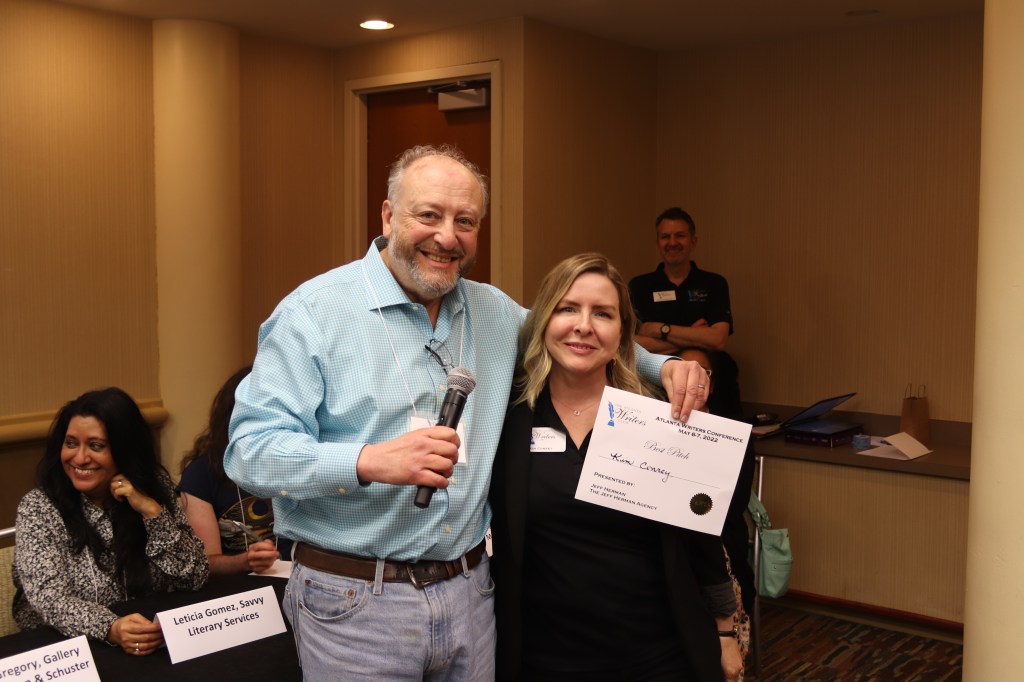
You’re Not a Murderer: You Just Have OCD, a memoir I co-authored with my daughter, won Best Pitch at the 2022 Atlanta Writers Conference, but you don’t have to write an entire memoir to talk about OCD. Share whenever you can. Bring the light.
People who feel called to discuss mental illness with others, especially an often misunderstood disorder such as OCD and Harm OCD, know what I mean by “the look.” The person you’re talking with has likely never heard of it or thought they knew what it was and your explanation is imploding their entire concept of what they thought it meant. Or maybe they are just screaming somewhere in their head, “For God’s sake don’t say, ‘I’m so OCD’ in front of this woman!” Some people have made such a habit of it that they have to train themselves to stop misusing it.
Then again, some people are just uncomfortable discussing mental health. Perhaps these are things they were taught to whisper about in hushed tones. Perhaps they never knew if this whispering was meant to protect the people who were actually suffering or meant to silence those suffering so as to not embarrass the family. Whatever the case, the silence has left legions of people trembling in the shadows, afraid to speak up, and if they’re not speaking up, they’re not getting help. This is why my daughter and I decided to write about our journey with Harm OCD (an intrusive, unbidden, terrifying thought of harming oneself or others). I remain convinced people are ending their lives over this disorder in the belief that they are doing the world a favor by taking themselves out of it. No one has told them intrusive thoughts can be, and often are, Harm OCD. No one has told them, as my daughter’s therapist told her, “thoughts are not things.”
So, we share. It’s that simple. You don’t have to write an entire memoir to talk about OCD. Share whenever you can. Send a light into the shadows where someone is just barely hanging on. Maybe the person you talk to today doesn’t seem to “get it.” Maybe you even get “the look.” What we don’t know about is the person that individual may meet tomorrow. What we share, ripples. We don’t know where those ripples lead, but we have faith that they keep going. Help remove the stigma and bring hope to others dealing with this misunderstood condition. Let them know they can be free.
Thank you to Jeff Herman of the Jeff Herman Literary Agency for “getting it.”




 Harm OCD: You Are Not Alone